Leave A Message
If you are interested in our products and want to know more details,please leave a message here,we will reply you as soon as we can.
submit
banner

Brush head machine

Home

Brush head machine

  • Global Wall & Block Brush Market: Landscape and Entry Feasibility Analysis
    Global Wall & Block Brush Market: Landscape and Entry Feasibility Analysis
    Oct 05, 2026
    The global wall and block brush market sits at a compelling intersection of steady demand, fragmented competition, and evolving material innovation. For businesses considering entry—whether from adjacent industries, other brush segments, or upstream/downstream positions—understanding the market’s size, growth trajectory, and structural barriers is essential.   According to industry data, the global block and wall brush segment reached approximately USD 1.76 billion in 2024 and is projected to grow at a 3.2% CAGR through 2035, reaching USD 2.5 billion by the end of the forecast period. Within the broader paint tools category, which totals USD 8.26 billion globally, wall and block brushes represent the largest product sub-segment at roughly 56% of total brush revenue, driven by residential renovation, commercial construction, and industrial surface preparation applications. Regionally, North America leads in per-capita consumption, supported by strong home improvement spending and a mature professional contractor base. However, Asia-Pacific is the fastest-growing region, accounting for 38.2% of global revenue and expanding rapidly on the back of urbanization in China, India, and Southeast Asia. Synthetic bristle variants dominate the market with a 52.4% share, as water-based coatings continue to displace solvent-based paints worldwide.   For companies entering from unrelated sectors, the feasibility is moderate with significant caveats. Core manufacturing technology for wall brushes is mature and accessible, and raw materials—wood/plastic blocks, nylon/polyester filaments, and ferrules—are widely available from multiple suppliers, keeping supplier bargaining power low. However, substantial barriers remain: established distribution networks, brand recognition among professional painters, and price competition from Asian OEMs. The top five players hold only about 34.7% of the market, leaving room for newcomers, but success requires either significant pricing advantage or clear product differentiation such as ergonomic design or eco-friendly materials. Capital requirements for production setup are moderate compared to precision industries, making this path viable for companies with strong marketing or e-commerce capabilities.   For companies already producing toothbrushes, industrial brushes, or specialty brushes, entry into wall and block brushes is highly feasible. The core production processes—bristle filling, trimming, and handle assembly—share fundamental similarities, allowing partial utilization of existing equipment and technical expertise. A notable example is China’s Yuantan industrial cluster, where manufacturers successfully expanded from basic wall paint brushes into industrial cleaning brushes, street sweeper brushes, and tile polishing brushes by leveraging existing supply chain infrastructure and production know-how. The primary challenge lies in channel diversification rather than manufacturing capability, as wall brushes serve distinct B2B contractor and DIY retail channels.   For upstream material suppliers and downstream industry players, feasibility varies by position. Upstream material companies such as filament extruders and wood/plastic processors possess raw material cost advantages and technical understanding of bristle performance, but lack final assembly expertise and end-customer relationships. Vertical integration can improve margins but requires investment in secondary production lines and quality control systems. Downstream paint brands and distributors already have established customer relationships and brand equity. Many leading paint companies already offer branded brush lines through private-label partnerships. For these players, in-house manufacturing can strengthen margin control and product bundling strategies, though it may divert focus from core competencies.   The wall and block brush market is not a high-growth, disruptive space—but it is a stable, cash-generating segment with predictable replacement cycles and low technological risk. The most successful entrants will not be those chasing explosive growth, but those who can leverage existing strengths—whether manufacturing scale, material expertise, or channel access—to carve out profitable niches. For cross-industry players, the smartest path is often through acquisition or private-label partnerships rather than greenfield entry. For adjacent brush manufacturers, the question is not whether to enter, but how quickly to align product portfolios with regional construction trends and the accelerating shift toward sustainable, synthetic-fiber solutions.
    Read More

  • How to Lower Paint Brush Production Costs Without Hurting Quality
    How to Lower Paint Brush Production Costs Without Hurting Quality
    Sep 07, 2026
    For many paint brush manufacturers, cutting costs almost always means cutting corners on materials. It seems like the easiest way to squeeze margins is to use cheaper bristles, thinner ferrules, or lower-grade components. But this approach almost always backfires: it leads to higher rejection rates, more customer returns, and a damaged brand reputation. The truth is, most waste in brush production happens in hidden, process-related areas—not in the visible raw materials. With targeted adjustments to material selection, dimensional control, and assembly efficiency, you can reduce total costs without sacrificing product quality.   Wedge material is one of the most underrated cost drivers in brush production. Traditional wooden wedges have low upfront material cost, but they carry heavy hidden expenses. They absorb moisture and swell, causing uneven bristle tension and “fish mouth” defects that raise scrap rates. They also splinter during machine insertion, jamming equipment and creating unplanned downtime. Virgin plastic wedges solve these issues but come at a premium price.   PE regrind wedges strike the optimal balance. Made from recycled polyethylene processed to tight specifications, they deliver the same dimensional stability, moisture resistance, and machine compatibility as virgin PE, but at a significantly lower material cost. They run cleanly on automated assembly lines, produce no splinters, and maintain consistent bristle packing batch after batch. For an internal component hidden inside the ferrule, there is no quality tradeoff—only cost savings.   Most manufacturers don’t realize how much raw bristle material they waste on poor dimensional control. A common shortcut is using thicker wedges to reduce bristle volume inside the ferrule. But this practice actually wastes more material than it saves: it causes misaligned bristle insertion, creates tip defects, and forces machines to reject or rework a higher share of units.   From our production experience, keeping the combined wedge and ferrule wall thickness below 0.6 mm is the golden standard. This ratio maximizes bristle retention, minimizes tip defects, and allows automated bristle-setting machines to run at peak efficiency with minimal waste. When your tooling and components are calibrated to this standard, you use exactly the right amount of bristle material—no more, no less.   Labor and downtime are two of the largest costs in any production facility. Low-quality components don’t just hurt product quality—they slow down your entire line. Wooden wedges require frequent machine cleaning to remove splinters, and inconsistent dimensions mean constant setup adjustments.   As a manufacturer of both brush-making equipment and PE regrind wedges, we design our components to work seamlessly together. Precision-engineered wedges reduce changeover time, eliminate splinter-related jams, and let your line run faster and longer. Higher throughput with less maintenance means lower cost per unit—without any drop in quality.
    Read More
  • The Unsung Hero of Brush Quality: Precision Ferrule Manufacturing
    Mar 05, 2026
    In the world of brush making, much attention is lavished on bristles, handles, and filling precision. Yet, there is a quiet component that holds everything together—literally. The ferrule, that seemingly simple metal sleeve connecting handle to bristles, plays a critical role in both structural integrity and aesthetic appeal. When ferrule quality falters, even the finest bristles and most ergonomic handles fail to deliver a premium product. One of the most persistent yet overlooked challenges in ferrule production is surface deformation. Bulging, uneven contours, and inconsistent shaping plague manufacturers, creating assembly difficulties and diminishing the perceived quality of finished brushes. These imperfections are often accepted as inevitable—until now. Zhangzhou Hengyu Automation introduces the Ferrule Making Machine ZDTKJ-IV, a precision-engineered solution that elevates ferrule manufacturing from a necessary step to a competitive advantage. At the heart of this machine lies an integrated shaping mechanism that ensures flawless dimensional consistency across every ferrule produced. This intelligent system actively corrects for material variations and forming stresses, eliminating unsightly bulges and delivering perfectly smooth, uniform surfaces. The result is a ferrule that not only functions flawlessly but enhances the overall aesthetic of your finished brush. Versatility is engineered into every aspect of the ZDTKJ-IV. It accommodates an extensive range of ferrule types—beveled, straight, oval, and more—with a width adjustment range covering virtually all current market specifications. Whether you produce standard paint brushes or specialized industrial tools, this single machine adapts effortlessly to your product portfolio. The true innovation, however, lies in its approach to production flexibility. Traditional ferrule making requires complete die changes for different products—a time-consuming, costly process that ties up capital in redundant tooling and extends changeover downtime. The ZDTKJ-IV liberates manufacturers from this burden. Only the letter mold and mandrel require during product changeovers, not the entire die set. This modular approach dramatically reduces both setup time and the inventory of costly dedicated tooling. The economic implications are profound. Manufacturers can respond to custom orders with unprecedented agility, experiment with new designs without prohibitive tooling investments, and maintain leaner, more efficient operations. The savings in mold costs alone represent a significant reduction in capital expenditure, while reduced downtime translates directly to increased productive capacity. In an industry where margins are tight and quality expectations ever-rising, the ZDTKJ-IV offers a pathway to differentiation through operational excellence. It transforms ferrule production from a cost center into a strategic capability—one that enables faster response to market demands, greater design freedom, and consistent, repeatable quality that builds brand trust. Because at Hengyu, we understand that precision is not an accident. It is engineered, one component at a time. Elevate the unseen elements of your brush quality. Contact us to discover how the ZDTKJ-IV Ferrule Making Machine can streamline your production, reduce your tooling costs, and deliver the flawless consistency your products deserve.
    Read More
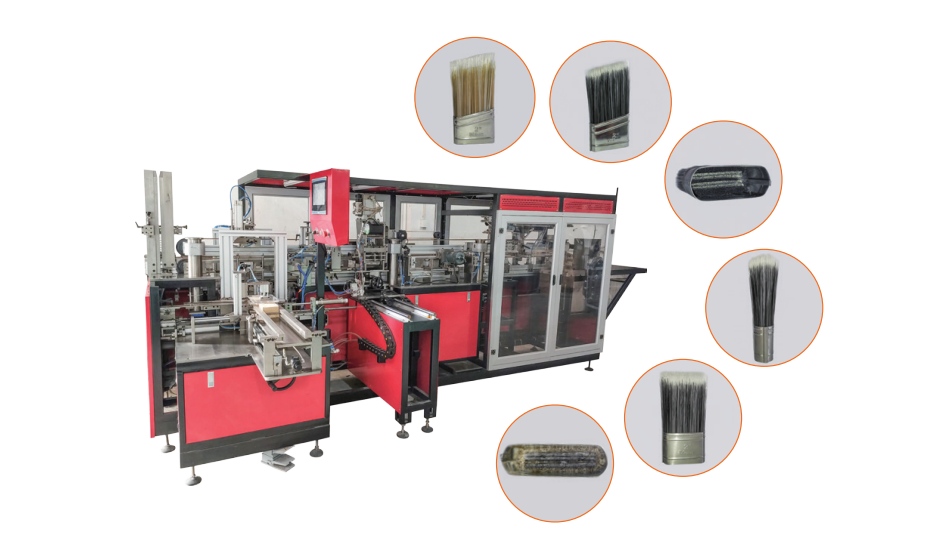
  • Revolutionize Your Brush Production: Introducing the YTSZMJ-II Round Brush Head Machine
    Jan 15, 2026
    In the competitive brush manufacturing industry, maintaining quality while controlling costs is a major challenge. Relying on skilled workers for consistent brush head quality leads to high costs and limits growth. Zhangzhou Hengyu Automation addresses this with the YTSZMJ-II Round Brush Head Machine. This precision automaton solution ensures impeccable consistency with material dosing accuracy of ±0.2g and produces uniform, aesthetically perfect brush heads for various shapes. The machine significantly lowers production barriers, making it easy for new operators to use. Its durable design and low maintenance requirements effectively reduce long-term operating costs, offering a strong return on investment. Move towards a more efficient and controllable manufacturing future. Contact us to learn how the YTSZMJ-II can integrate into your production line. Zhangzhou Hengyu Automation Technology Co., Ltd. – Precision Engineered for Your Success.
    Read More

leave a message

leave a message
If you are interested in our products and want to know more details,please leave a message here,we will reply you as soon as we can.
submit
Contact Us: info@hengyucom.com

home

products

WhatsApp

Contact Us